

Field Guide · 6 min read
Artificial turf vs. real grass in Charleston.
By the Marsh & Mane crew · Updated
Key takeaways
- Turf is strongest where grass struggles: deep shade, sand, dogs and high traffic.
- Grass stays cooler underfoot in direct July sun; turf needs design choices to manage heat.
- A turf lawn is only as good as its base — excavation, compaction and grading matter most.
- Turf eliminates mowing, irrigation, fertilizer and most weeding.
Why grass is hard in the Lowcountry
Charleston lawns fight on several fronts at once. Much of the region sits on sandy, fast-draining soil that holds few nutrients. Mature live oaks cast deep shade that warm-season grasses like St. Augustine, Bermuda and Zoysia tolerate poorly. Summer brings heat and humidity that invite fungus, while winter leaves warm-season lawns dormant and brown.
Add dogs, kids and afternoon thunderstorms, and many yards end up as a patchwork of thin grass, bare sand and mud.
Where artificial turf wins
Turf solves the problems natural grass cannot, provided it is installed on a properly built base.
- Year-round color: green in August and February, with no dormant season.
- No mowing, watering, fertilizing or aeration.
- Shade: turf looks the same under a live oak as it does in the sun.
- Pets and traffic: no dead spots, worn paths or muddy paws.
- Drainage: a graded stone base and perforated backing typically shed water faster than compacted native soil.
Where natural grass still wins
Real grass is cooler underfoot in direct midday sun, because it transpires water. It is also a living surface that supports soil life, and some homeowners genuinely enjoy caring for a lawn.
If your yard gets full sun all afternoon and you want to walk barefoot at 2 p.m. in July, plan shade, lighter-colored fiber blends and cooling infill — or keep some natural planting in the mix.
The part most people overlook: the base
The difference between a turf lawn that looks great for fifteen years and one that ripples, puddles or smells is almost always what is underneath. A proper install removes existing sod and soil, lays and compacts a crushed-stone base graded away from the house, secures the perimeter, and hand-finishes the seams.
In sandy Lowcountry soil, compaction and edge restraint are what keep the surface flat over time.
Mixing turf with native planting
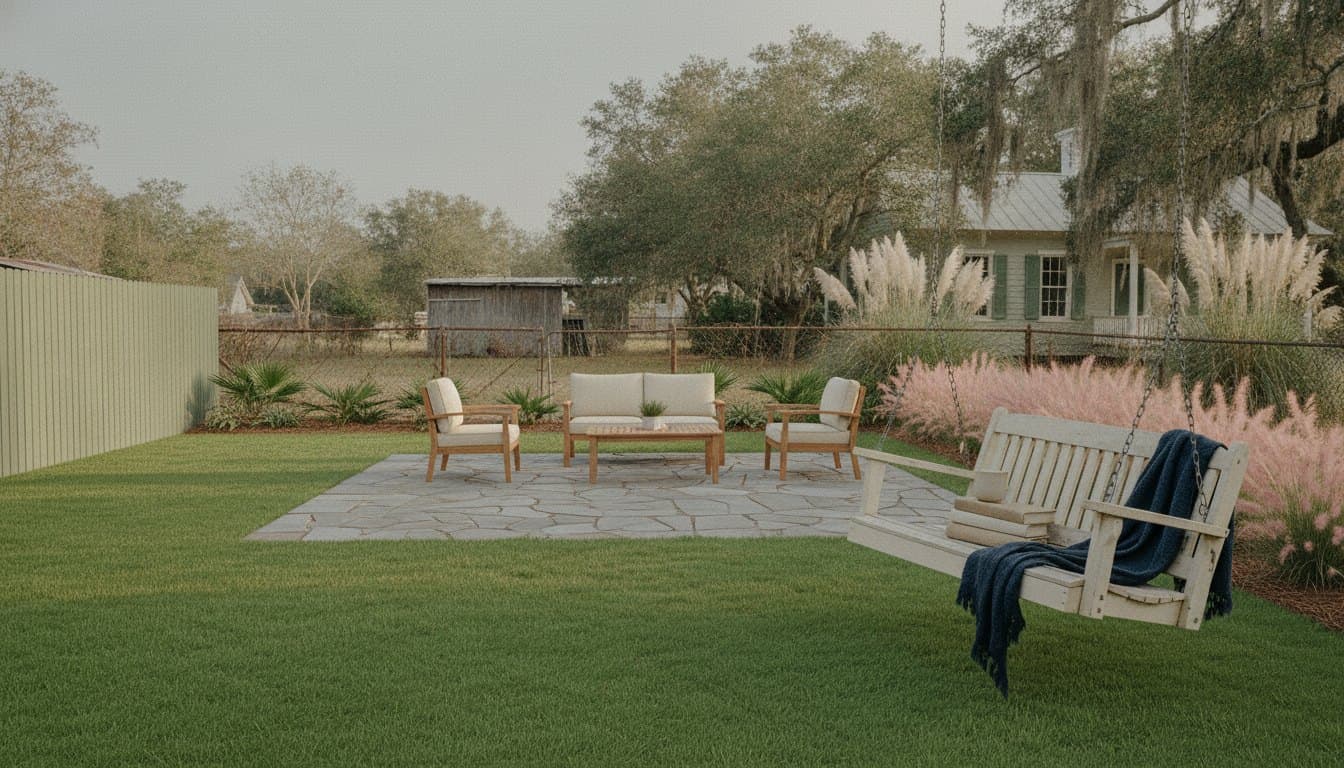
The best-looking Charleston yards rarely go all-turf. Framing a turf lawn with native and coastal plants — saw palmetto, muhly grass, ferns under the oaks, sea oats near the coast — keeps the yard feeling natural, adds habitat and softens hardscape.
Common questions
Modern multi-tone turf with a tan thatch layer looks very close to a healthy lawn, especially when edges are tucked and seams are hidden. Poor installs, not the product, are what usually look fake.

Ready to ditchthe mower?
Let's build a yard worth hanging out in.
Good turf. Good times.